Loading trail…

Grandeur Point
Free — you'll pick up right here.
Watch this trail
Sign up to watch it — saving subscribes you to gate, closure and report changes.
Arizona
We won't guess. Here is exactly what we do and don't know.
What we do know
Inside Grand Canyon National Park
National Park unit boundary is mapped — agency alerts for it feed this page automatically.
Boundary data
What's missing
No access route mapped
We don't yet know which road reaches this trailhead, so we can't tell you if it's gated.
Nobody's filed a report here yet — be the first.
Grandeur Point
AI-suggested draft · review before you go
No elevation data on file for this trail.
This location offers one of the better views of the layers and depths of the canyon in the area around Grand Canyon Village. It also provides especially fantastic aerial views of the switchbacks on the upper and middle portions of Bright Angel Trail, as well as a view of 3-Mile Resthouse far below. Grandeur Point is a popular stop along the Rim Trail between Grand Canyon Visitor Center and the Village, as well as a popular spot for sunset that is often less crowded and more easily accessible spots like Mather, Lipan, or Hopi Points. Grandeur Point is located along the Rim Trail about 0.5 miles (0.8 km) west of Yavapai Point and Yavapai Geology Museum. It can also be reached via Parking Lot A and Park Headquarters by following the paved trail past McKee Amphitheater and out to the Rim Trail. After following this path for 0.4 miles (0.6 km), turn right and follow the Rim Trail east for nearly 0.5 miles (0.8 km). The view is worth the walk! Geology Grandeur Point offers an especially dramatic view of Bright Angel Canyon, which slices directly across Grand Canyon and cuts deep into both the South and North Rims. Grand Canyon Village sits near the southern head of this massive side canyon, which has formed along a geologic structure known as the Bright Angel Fault. Many faults, large and small, cut the rock layers of Grand Canyon, but the Bright Angel Fault is probably the most famous. Movement of rocks along this fault has created a major conduit for water flowing down to the Colorado River, including Garden Creek from the South Rim (fed by springs at Indian Garden, far below) and Bright Angel Creek from the North Rim (fed by Angel Spring and Roaring Springs, the source of all drinking water within the park). Since movement along faults causes breaks in the shear cliffs of Grand Canyon, they often serve as access points for trails descending from the canyon rims. Where the switchbacks of the Bright Angel Trail descend through the break in the shear cliff of tan Coconino Sandstone several hundred feet below the rim, one can clearly observe the offset along the Bright Angel Fault. The displacement along this portion of the fault is about 200 feet (60 m), with the western side of the fault uplifted relative to the eastern side. However, this normal displacement along the Bright Angel Fault represents only the most recent chapter of its long history; like other major faults in Grand Canyon, the Bright Angel Fault traces its origin back to the formation of the proto-North American continent about 1.7 billion years ago. Since its initial formation, the Bright Angel Fault has been reactivated several times, sometimes as a normal fault (such as it is now) and sometimes as a reverse and/or strike-slip fault.
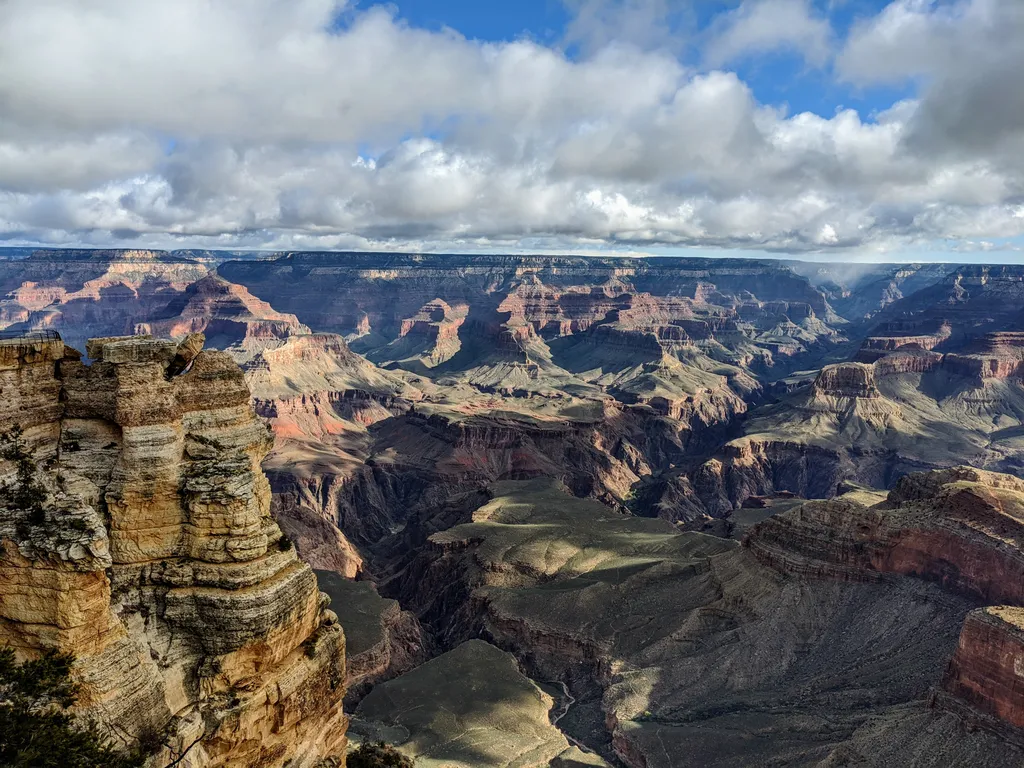
Rim Trail - Mather Point
~1 min drive
The Rim Trail is a mostly paved path that stretches roughly 13 miles (21 km) along the southern rim of Grand Canyon from South Kaibab Trailhead in the east to Hermits Rest in the west. Most people won't hike the whole trail in one go, but walking short sections of the rim can…
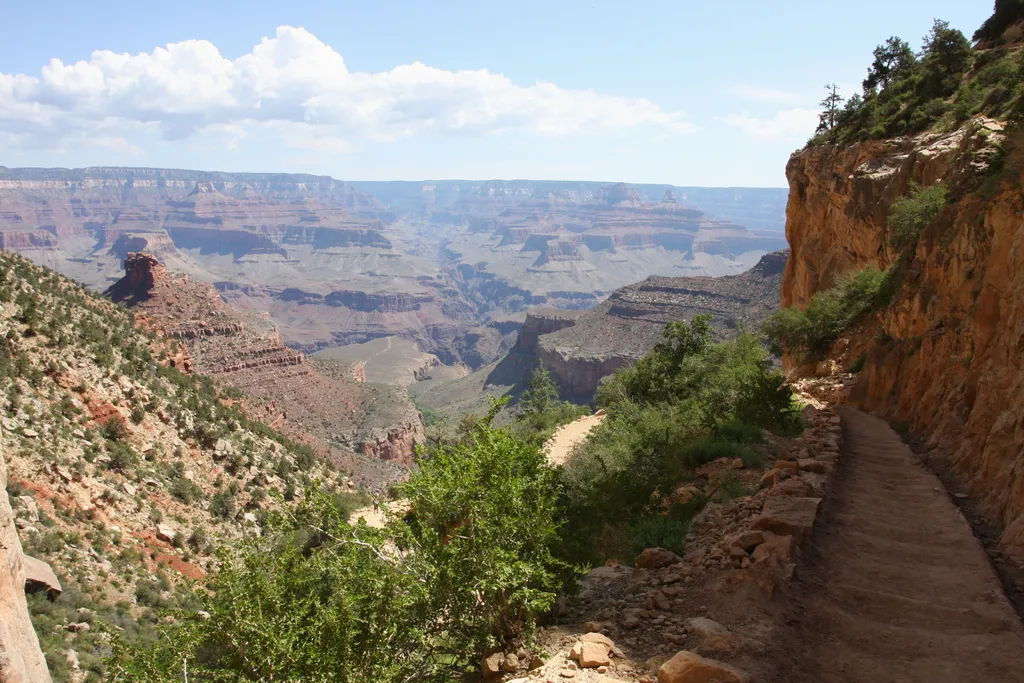
Bright Angel Trail
~2 min drive
The most popular hiking trail into Grand Canyon, the Bright Angel Trail lets hikers walk in the footsteps of the canyon's Indigenous peoples, miners, and early tourists, as they descend into the canyon's depths. Offering outstanding views, morning and afternoon shade, resthous…
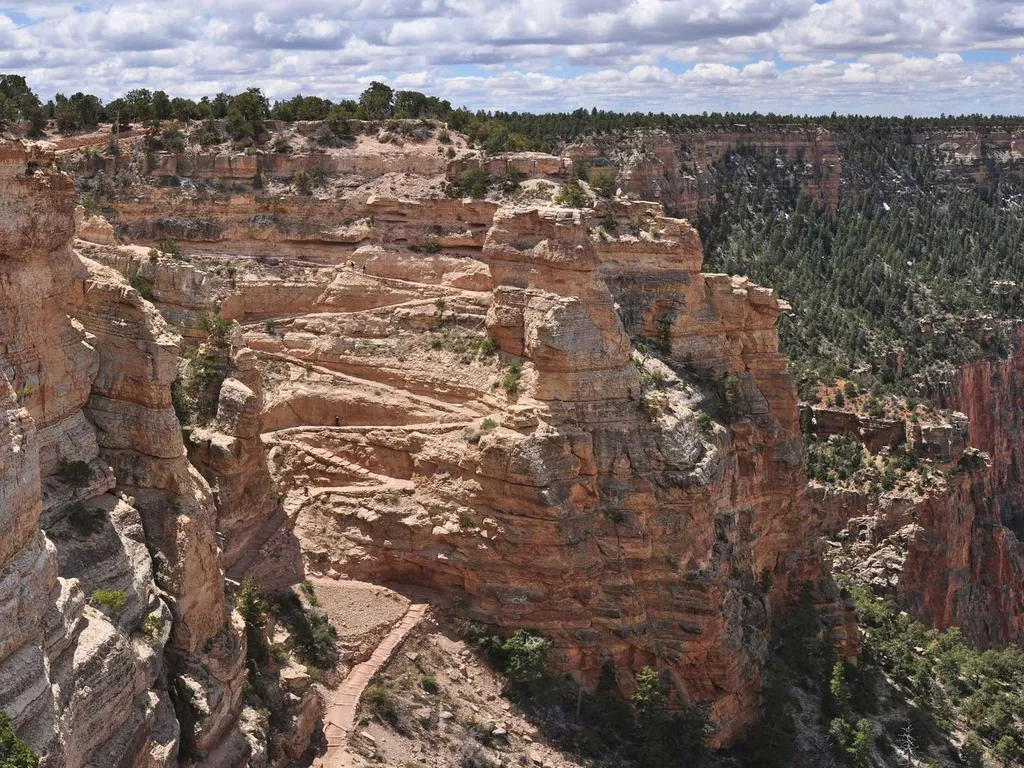
South Kaibab Trail
~4 min drive
Know Before You Go Before heading down into the canyon, consult the signs at the trailhead, and scan the QR code for trip planning, current weather, water availability, and trail information/closures. (or visit our Key Hiking Messages webpage). Trail Reopenings and Current C…
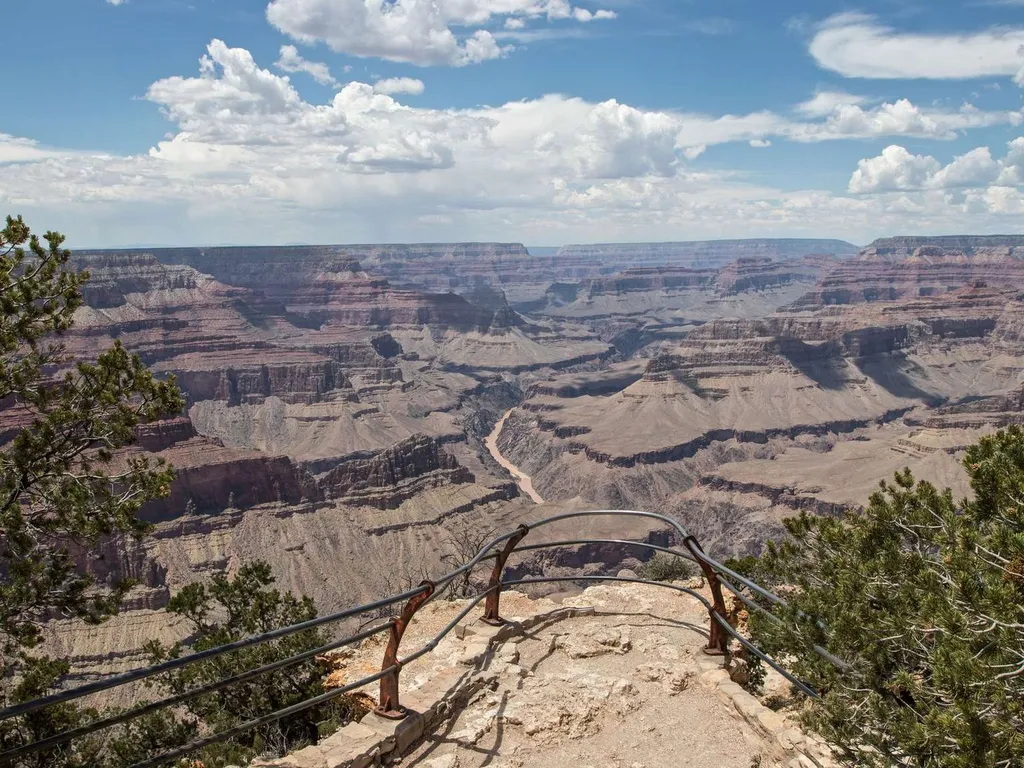
Mohave Point
~4 min drive
Another spectacular point for watching sunset, Mohave Point offers excellent views of the Colorado River deep in the canyon below. From here you can also see the Salt Creek, Granite, and Hermit rapids. Below this viewpoint, 'The Alligator' named by Emery Kolb points across th…
Hermit Trail Grand Canyon
~9 min drive
Louis D. Boucher, the "hermit" of Hermit Creek basin, lived in this area for 20 years. Boucher built the Boucher Trail (west of the Hermit Trail) and seasonal residences at Dripping Springs and near Boucher Creek. Though socially active in the South Rim community, residents la…
Trail of Time: The Main Trail of Time Portal
~0 min drive
Starting from Yavapai Geology Musuem and walking west, once you have walked the short Million Year Trail 150 yards(136 m), you will encounter the second Trail of Time portal, which marks the beginning of the main Trail of Time, that represents the two billion year timeline of…
Animal Life Appeared About 630 Million Years Ago
~0 min drive
The record of life and the stories of the diverse creatures that once lived here are captured in the rocks that make up the walls and cliffs of Grand Canyon today in the form of fossils, tracks, and various clues deciphered by paleontologists. This interpretive exhibit along…
Trail of Time: Headquarters Portal (Parking Lot A)
~1 min drive
To get to this portal, walk the spur trail near Park Headquarters and parking lot A. It is a 0.4 mile (0.65 km) to the portal at the junction with the Canyon Rim Trail, (Trail of Time). This portal sits at 1,000 million (1 billion) years ago along the Trail of Time, a period…
Zuni Trail
~1 min drive
0.3 mi · Easy
Grand Canyon's Rocks Are Incredibly Old
~1 min drive
Geologically speaking, Grand Canyon is considered to be a "young" feature, much of it having been eroded in just the last 5-6 million years. But the ages of Grand Canyon's rocks are a different matter entirely, spanning over 1.5 billion years of Earth's history. The oldest kno…