Loading trail…

Holzwarth Historic Site - Bridge Over the Colorado River
Free — you'll pick up right here.
Watch this trail
Sign up to watch it — saving subscribes you to gate, closure and report changes.
Colorado
We won't guess. Here is exactly what we do and don't know.
What we do know
Inside Rocky Mountain National Park
National Park unit boundary is mapped — agency alerts for it feed this page automatically.
Boundary data
What's missing
No access route mapped
We don't yet know which road reaches this trailhead, so we can't tell you if it's gated.
Nobody's filed a report here yet — be the first.
Holzwarth Historic Site - Bridge Over the Colorado River
AI-suggested draft · review before you go
No elevation data on file for this trail.
Beneath you runs the headwaters of the Colorado River! It provided water to the homesteaders who called this valley home over a century ago. What was the Homestead Act? With the goal of promoting development in the American West, President Lincoln passed a law in 1862 that promised any family or individual 160 free acres on the frontier given they inhabit the land for five years and “improve it”. Improvement was defined as clearing, building structures, cultivating plants and livestock, etc. How did the Homestead Act Impact the Kawuneeche Valley? While a total of 270 million acres were claimed under the Homestead Act, here in the Kawuneeche Valley only a little over two dozen claims were successfully staked between 1880 and 1927. This impacted roughly a quarter of the total area. There were many obstacles to improving the land, and farmers and ranchers saw little success converting the area to cropland or ranchland. There were poor, swampy soil conditions, a lack of accessible pastureland, and a natural competition between domestic livestock and native wildlife. Not only that, but day to day activities were impacted by long, cold winters. Imagine having to walk through three feet of snow to use the outhouse! Despite the harsh landscape surrounding them, homesteaders were keen to adapt the landscape to suit their needs, even though it was at the expense of the natural character of the ecosystems. They removed native vegetation and planted non-native plants and grasses. They also removed beavers and dammed, re-routed, and channelized rivers and streams. They built a device near this bridge, with a wheel and headgate, to divert water to pastures. If you stood in this place a hundred years ago, you would have seen a wetter landscape with willow dominated wetlands mixed with riparian forest. You would have seen an abundance of beavers, natural grasses instead of the non-native Timothy grass that was planted by homesteaders, and more channels and tributaries of the Colorado River. When the Holzwarth family arrived in 1917, they followed in the footsteps of other homesteaders and sought the goal of creating their own habitable oasis in the Rockies. But what was their background to qualify them as ranchers? And how did the family settle on the Kawuneeche Valley?
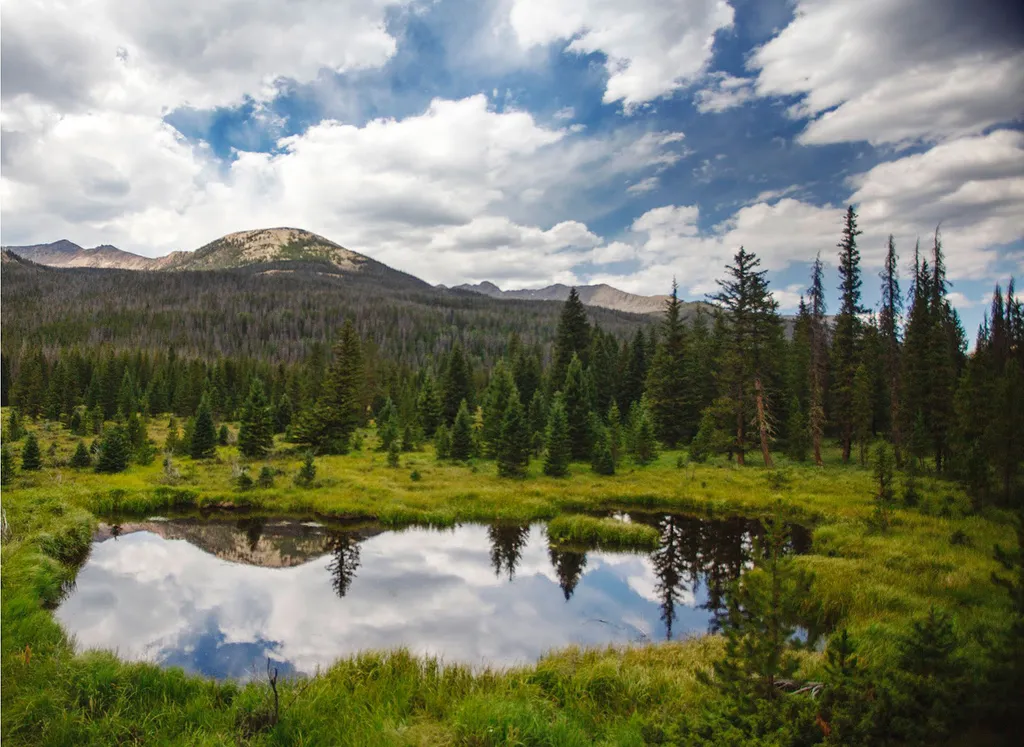
Beaver Ponds Picnic Area
~2 min drive
<p>Beaver Ponds Picnic Area is an excellent location to enjoy the peacefulness of the Kawnueeche Valley.</p> <p>This picnic area has tables overlooking two large ponds where visitors can enjoy the scenery while stopping to have a meal. Water sources like the ones found here pr…
Timber Lake Trail
~3 min drive
5.8 mi · Moderate

Grand Ditch Trail
~6 min drive
30 mi · Easy

Colorado River Trail
~6 min drive
3.7 mi · Easy

Bowen Gul Og Interp Trl
~8 min drive
1.0 mi · Easy

Tonahutu Creek Trail
~10 min drive
27 mi · Expert
Scenic Route
~10 min drive
1.4 mi · Easy
Blue Ridge
~11 min drive
7.1 mi · Hard

Viewpoint
~11 min drive
1.8 mi · Easy

Ute Trail
~12 min drive
9.2 mi · Easy